Tuesday, June 16, 2015

Discrimination against Buffalo Soldiers and Native Americans


Essential Question:  Was the discrimination that the Buffalo soldiers and Native Americans faced intentional or did the White settlers and federal government actually believe that what they were doing was just?

       For the last few weeks of school, the class has adapted to a new procedure than that of our usual.  It begins with someone creating a Google Doc and then sharing it with everyone in the class.  Then we create an essential question, analyze the given primary and secondary sources on the topic, and watch videos.  All the while we take notes on our assigned section for everyone to then learn the information.  

      We began last week with learning about the Buffalo soldiers and Native Americans who were discriminated against greatly.  The government thought that it would be best to allow Americans to expand westward into Native American territory, enforcing them to evacuate by using total war tactics against them.  Also, Shaman flooded the area with troops in attempt to wipe the remaining Native Americans out.  This meant that they had to leave their homes where they had lived their entire lives in comfort and tradition to go farther west and into other unknown territories.  


Image of the Buffalo soldiers.   http://www.buffalosoldiersw.com/id7.html


      After this arrangement of forcing them out of their territories, new laws were enforced upon the Native Americans and Buffalo soldiers.  Carlyle schools were created to educate the Native Americans and Indians were encouraged to leave behind their roots and to blend in with the Americans.  Everybody believed that the Natives should be assimilated into society.  The Native American's land was split up and sold for use.  

     The discrimination toward the buffalo soldiers and Native Americans was intentional because the white settlers and government knew that "assimilating" an entire ethnicity of people and their way of life was wrong, but proceeded to do so.  They did this because they wanted everyone to be the same and for there to not be any differences.  Also, because they wanted to extend the boundaries for more civilization and make use of the land for themselves.


Wednesday, June 10, 2015


Essential Question: Were Carnegie and Rockefeller robber barons or captains of industry?

To learn about Carnegie and Rockefeller's roles in the 19th century of America, we began class differently than our usual process. The class was broken up into the small separate groups and we all had to create an essential question together and then get it approved by Mrs. Gallagher. This was very interesting because normally we are given the essential question upon introduction of the unit. We came to find that the definitions of the terms mentioned in the essential question were... a.) Robber Baron- seen as corrupt, unsportsmanlike, bribed government officials, bought out or destroyed rivals, created giant monopolies and trusts, citizens had a love hate relationship with them, and b.) Captains of Industry-business leaders.  


This is an image of Carnegie and Rockefeller.
http://sites.psu.edu/rcldiacont/2013/09/20/billionaire-anomalies-the-robber-barons/

Next, as a class we viewed the multiple ABC-Clio videos to provide us with information on the two men and their roles during the 19th century. Each group had the responsibility of taking notes on a certain topic that was frequently mentioned throughout the videos. These topics include main ideas, key people, important events/key dates, and essential terms. As a class, we created a google doc with everyone on it to share our notes. This made it easier for everyone to enjoy the videos and learn all of the information without having to scramble down all sorts of notes the whole time.

After gathering all of the evidence and information on Carnegie and Rockefeller, it seems most appropriate to remember them as captains of industry. They both made tons of accomplishments that helped America to grow. For instance, Andrew Carnegie built hundreds of libraries which helped to educate the public and offer different sources for people to read. He was also known for his huge production of steel in the U.S. which was very important since steel was so widely used. Carnegie used vertical integration which controlled transportation, manufacturing and sales. All of these things helped to rebuild America which makes Carnegie a captain of industry.

Rockefeller was also a captain of industry for similar reasons to Carnegie. Rockefeller had a standard oil company and with this he helped to advance the economy by buying rival companies. He also helped the consumer and supported education. Both of these men helped improve America economically and industrially which made them captains of industry, not robber barons.


Thursday, April 30, 2015

From Whom Did Freedom Come From?


The essential question: Who 'gave ' freedom to enslaved Americans? Did freedom come from above or below? To what extent were Abraham Lincoln's actions influenced by the actions of enslaved American's


     In class, we focused on the essential question and deciding whether freedom given to the enslaved Americans came from above or below.   We also focused on Abraham Lincoln's actions and how they were influenced by the enslaved American's.  To better our understanding on the subject, we began by looking at an image of Abraham Lincoln freeing an enslaved man.

'Freedom to the Slaves'
http://www.edline.net/files/_DMF3y_/abfc09536fdb31443745a49013852ec4/Freedom_to_the_Slaves.jpg


  We then discussed what a social pyramid is and what it means for freedom to come from above or below.  Next, everyone looked at either Document X(letter from General Ambrose E. Burnside to Secretary of War Edwin M Stanton) or Document Y(the engraving).  These documents provided different examples of the actions the slaves were taking and how people reacted to them.  Lastly, we watched the Ken Burns Civil War Clips which described how the fugitive slaves began following the Union Army and Lincoln's actions that made differences and those that didn't.

   For example, in Document X, General Ambrose E. Burnside describes how all of the slaves from nearby plantations are looting the town that Burnside and his men took over.  He and his men were very anxious because there was such a large amount of  "fugitive"slaves whose behavior was wildly inappropriate since they were taking things from the residences and hiding from their overseers.  In this case the freedom comes from below since the slaves took action by escaping their plantations and looting the towns.

  Next, in the engraving, the slaves from Jefferson Davis' slaves just up and left his plantation and went to the bayou because they knew that the Union soldiers would be there and that they would provide protection. This is yet another instance of freedom from below since the slaves made the clever decision to not only escape their plantation but to run somewhere that they would be surely safe.


Engraving, “Slaves from the plantation of Confederate President Jefferson Davis arrive at Chickasaw Bayou, Mississippi,” 1863
 http://www.edline.net/files/_DMF2g_/25617cd6768f5fcd3745a49013852ec4/Docs_XY_Above__Below.pdf

  In life today, the freedom coming from either above or below is still an issue.  There are so many examples that could be said to describe how unjust society is today in certain aspects.  For example, there have been numerous instances in this past year such as the one in South Carolina where a colored man was killed on the spot /violently dealt with for no valid reason by a white officer.  Also, a recent popular topic is the Bruce Jenner gender change.  There was just an interview on Bruce Jenner where he told millions of people about the struggles he faced before he came out about being a woman and the horrible ways he is being treated by the public now.  He stated how it was impossible to get out of his home without the paparazzi snapping photos of his every move and harassing him about his gender identity.  These are just a few instances that show there really isn't any total freedom in the world today especially because of racism and gender identity acceptance.


Wednesday, April 8, 2015

Civil War Battle Scavenger Hunt

Essential Questions: Who was the ultimate victor in each of the theaters of war: East, West, Naval?
What are some commonalities you can identify in the reasons for the results of the battles?

    To begin our research on the different battles within the Civil War, we each received one of the twenty battle descriptions.  Then, we had to find out key information for our assigned battle such as the victor, image, theater, date/place, and two bullets explaining the results of each battle.  Next, we created Google docs that can be shared and QR codes.  Our next step in the process was to discuss with the class where our battles will be placed throughout the school.  Finally, we were able to proceed with the scavenger hunt!

After completing the scavenger hunt over the course of two class periods, we all got together using Padlet to share our thoughts on the main victors of each theater.


Referring back to the essential question, there were clear victors in each of the theaters.  In the Western theater, the clear victor was the Union army because it had more access to supplies and a larger army than that of the Confederates.  Next, in the Eastern theater, the ultimate victor was not as clear as in the Western theater.  The Union army won many of the battles but so did the Confederates.  This was mainly because of the casualties on both sides.  Also, both sides had different strategies that were effective such as the ambushes by the Confederates and the cutting of railroads by the Union army.  Lastly, the Union army was the victor of the Naval theater because they had more supplies, men and a more organized navy. Overall, the Union army was the victor of both the Western and Naval theaters but the victor of the Eastern theater is unclear.

For example, at the Battle of Fort Henry, the Union army was victor due to the strong, organized navy.


Image.  Civilwartalk.com  
http://civilwartalk.com/threads/153-years-ago-this-friday-civil-war-battle-of-fort-henry.109216/


Different commonalities among the results of the battles are easy to tell for the Western and Naval theaters since the Union army was the victor in both.  The Union army was much larger, had more access to supplies due to all of the railroads close by.  These advantages clearly helped them defeat the Confederate army in both the Western and Naval theaters.  In the Eastern theater, the commonalities are not as constant.  The Confederate army often had not enough men but they had good military strategies.  Likewise, the Union army had good strategies.  Both armies had many casualties which weakened them at certain points.  


Monday, March 16, 2015

Election of 1860 and the Secession that followed

Essential Question: How were the results of the election of 1860 representative of the deep divisions over slavery?

     The essential question has to do with the secession of states due to the election of 1860.  We learned how election impacted the secession by looking at the Civil War in Art and reading the information provided with the artwork.  Then in pairs we created videos on the Educreation app to demonstrate our knowledge on the topic.  There were deep divisions over slavery and the results of the election show this because lots of states in the South were pro-slavery states while the ones in the North were totally against slavery.  The North obviously voted for Lincoln who was against slavery.  Meanwhile, Breckenridge, a Southern democrat who believed there were no limits on slavery obviously gained the votes from the Southerners who wanted to preserve slavery.  


This map shows the states that seceded and those that chose not to.  The states colored in yellow (Missouri, Kentucky, West Virginia etc.) did not secede.  The states in the North colored in blue were all of the free states and in the South the states colored in red were the states that chose to secede.  The election of 1860 really caused a secession between the United States!

Here is the video my partner and I created:


The Civil War in Art.  http://www.civilwarinart.org/exhibits/show/causes/introduction/the-election-of-1860-and-seces

https://www.educreations.com/lesson/view/election/30122505/?s=S4CQ5U


Thursday, March 12, 2015

North vs. South: Strategies and Successes in the Civil War


There were many aspects of the North and South that caused their strategies to differ in beginning of the Civil War. Some of the most obvious ones were the difference in population and infrastructure. The North had a much greater population (21.5 million) than the South ( 9 million). Also, the North had twice as many railroads as the South which made the movement of supplies, food, and troops easy. Both the population size and the advanced infrastructure were two advantages the North had over the South. The North also had more money and was able to sustain its economy. I created graphs and used the fact and figures option to display these facts visually on my infogram. I chose these facts to be in my infogram because they showed how many advantages the North had over the South. Although the South had some advantages like having most of the nation's trained officers, it still wasn't enough for them to beat the North. This activity helped me understand the situations faced by the Union and Confederacy at the beginning of the war because both the North and South had may differences and advantages over each other.

Thursday, March 5, 2015

Slavery is the Elephant in the Room

 
Slavery is the Elephant in the Room!


      The essential question: How do we know the debate over slavery was the "elephant in the room" for American politics in the early 19th century?  The phrase "elephant in the room" means that an obvious truth is either not being addressed or is being ignored.  The obvious truth is that slavery is wrong in every way possible.  The politics and many others refused to accept this and instead were debating over which states would be free states and which states would be slave states.  They didn't spend any time trying to end slavery which is what clearly should have happened because they were so absorbed in the naming of states.  In class, to better our understanding of the matter, we looked at evidence for different events that had occurred during the 19th century involving slavery.  We then created a timeline to complete the activity which made all of the events easier to look at since they were all laid out together in order of occurrence.     


These are the timelines I created!


One of the first instances during the 19th century where slavery was the "elephant in the room" was in the Compromise of 1850.  The Compromise was created due to several points that were at issue.  A quote, "The United States had recently acquired a vast territory -- the result of its war with Mexico. Should the territory allow slavery, or should it be declared free? Or maybe the inhabitants should be allowed to choose for themselves? ".  This is just one of the points that shows how utterly inhumane the people were because all they cared about was whether the states were "free" or "slave-states".  None of these points had anything to do with slavery being wrong or the fact that it should be abolished.


  Next, in the crime against Kansas speech, Sumner stated strongly what his beliefs were on slavery.  He stated, "It is the rape of a virgin Territory, compelling it to the hateful embrace of Slavery; and it may be clearly traced to a depraved desire for a new Slave State, hideous offspring of such a crime, in the hope of adding to the power of Slavery in the National Government."  Although Sumner clearly showed in this excerpt and throughout the whole speech that slavery was wrong, not everyone listened.  The government still only cared about naming the states as either free states or slave states.  This shows how slavery was the "elephant in the room" because Sumner had the audacity to say it in front of so many people at his speech but the government still didn't care change its current ways.  

Another instance where slavery is the "elephant in the room" is the Dred Scott decision.  Dred Scott was a Missouri slave who traveled in the north with his slave owner who was elderly and sick.  When Scott's slave owner died, he argued that he and his wife Harriet were now free because they were in the north free states.  This case got so big that it was brought to trial.  In the end, SCOTUS ruled 7-2 against the Scott's.  There were then three effects of the Dred Scott decision on the slavery debate.  First, slaves were unable to sue in court since they technically were not citizens.  Next, enslaved people could not win freedom simply by living in a free state or territory.  Lastly, the Missouri Compromise was ruled unconstitutional and all territories were opened to slavery. The Dred Scott decision clearly ignores the fact or realizing that slavery in itself was completely wrong and instead SCOTUS focused on how "wrong" it was that an enslaved man and woman wanted freedom since they were in the free states.  


Newspaper article focusing on the Dred Scott decision.


Lastly,  John Brown's raid depicts an event that was planned in the hopes of ending slavery but was instead put to an end by the U.S. troops.  On October 16, 1859, Brown and 21 men including 5 African Americans attacked the federal arsenal at Harper's Ferry, Virginia.  They hoped to seize weapons from the arsenal so they could supply the slaves for the rebellion.  Brown claimed he had a dream of an uprising of enslaved Americans that would end slaver, punish slave holders, an lead the United States to moral renewal.  The U.S. troops put an end to it violently and Brown was sentenced to being hanged.  This is an example of someone standing up for what they believed was wrong and being hanged for it.  Brown knew slavery was wrong but no one else was willing to accept it or doing something like he did.


            John Brown 


   In conclusion, slavery was the "elephant in the room" for American politics in the early 19th century.  Based on all of the evidence that was analyzed, slavery clearly was being ignored in all of the issues.  The main focus seemed to be whether the states were declared "free" or "slave states."  Even when John Brown acted out in hopes to ending slavery, the U.S. troops immediately put an end to it and he was hanged!  Politics really ignored the fact that slavery was wrong and needed to be abolished which is why slavery was definitely the "elephant in the room" during the 19th century.  


Citations: 

Dred Scott, image, class notes, edline.net   http://www.edline.net/files/_BYIYQ_/a95c65dcd7b8c02c3745a49013852ec4/Elephant_in_the_Room_Lesson.pdf

John Brown, image, class notes, edline.net   http://www.edline.net/files/_BYIYQ_/a95c65dcd7b8c02c3745a49013852ec4/Elephant_in_the_Room_Lesson.pdf


SOURCE: The Works of Charles Sumner, vol. IV (Boston: Lee and Shepard, 1870- 1873), pages 125-249.

The Compromise of 1850 and the Fugitive Slave Act, website article, www.pbs.org  http://www.pbs.org/wgbh/aia/part4/4p2951.html


Monday, February 23, 2015

Slavery Took Over the 19th Century

One of the causes of the Civil War was the increase in slavery in American Society.  Slavery was huge in the 19th century because the people thought it was necessary in order to have a successful economy.  Although some people opposed slavery, they still used it because they didn't know any other way to run the economy.  

Slavery became entrenched in American society by the early 19th century.  One reason it became so entrenched was because of its mention in the Founders' Constitution.  Article 1 stated, "The Migration or Importation of such Persons as any of the States now existing shall think proper to admit, shall not be prohibited by the Congress prior to the Year one thousand eight hundred and eight, but a Tax or duty may be imposed on such Importation, not exceeding ten dollars for each Person."  This still promotes slavery and legalizes it as long as each enslaved person is taxed at such a price that doesn't exceed ten dollars.  People then began to trade slaves and use them more and more.  Statistics show that the amount of slaves in America increased from 69,000 in 1790, to 3,954,000 on the eve of the civil war.  That shows how big of an increase in slavery there was over time.  Another thing that caused slavery to become entrenched in American society was the invention of the cotton gin.  Cotton was not even considered as a commercial crop in 1790. By 1860, cotton had increased across the South. With the increase in cotton being planted, more and more labor was needed, so Southern planters began transporting large numbers of African-American slaves westward into the new cotton lands, where the planters used their social, political, and economic power to keep slavery legal. This resulted in a sharp demarcation between the Southern states.  The slave labor helped produce large amounts of economically valuable cotton.  Meanwhile, the rest of the nation, where the economy was more diversified and slave labor had been outlawed.  The website Mappinghistory     has a virtual tutorial showing the spread of slavery and cotton from 1790-1860.  There were many things that caused slavery to become entrenched in American society by the early 19th century.

A system of slavery based on race affects human dignity because it shows that the people within the system see people who look different or have different backgrounds as inferiors.  This shows that these people have no empathy and marginalize people based on their skin color.  It also means that they don't have good morals especially if they allow people to be treated so poorly because they are "different."  Systems like these ignore many human characteristics.  All humans are equal no matter what skin color or beliefs they have.  Just because someone appears different on the outside it doesn't mean that they aren't equal to everyone else and it certainly doesn't mean that they should be enslaved.  Overall, when a society uses a system of slavery based on race it affects human dignity because it shows that the people don't have empathy or good morals.  Systems like these tend to ignore human characteristics such as the fact that everyone is equal and should be treated equally.  Also, they tend to ignore that people have rights and should not be treated like animals.    

In conclusion, slavery became entrenched in the 19th century because of the mention of it in the Founder' Constitution and the invention of the cotton gin.  When societies use systems of slavery, it shows that the people don't really have a dignity and that they don't have empathy or great morals.  Lastly, these systems tend to ignore characteristics of humanity such as the fact that everyone is equal and that no one should be treated differently.    


Tuesday, February 3, 2015

Gender Equality

In the 19th century, and even before that in our history, women have been looked at as inferiors or less than men.  They have been separated from the rest of society and kept from doing many things that men could do.  In the 19th century there was nothing equal about the rights of women and men.


 In 1848, at the Seneca Falls Convention, many women and some men abolitionists gathered to demand the right to vote for women.  It was known as the first organized woman's suffrage gathering.  At the Seneca Falls Convention, the Declaration of Sentiments and Resolutions was published.  It listed all of the grievances in the ways women have been wronged.  The resolutions were demands from the women.  This was one of the ways the women tried achieving gender equality.  In a list of the laws and practices that women were forced to follow called "Rights of Women", it shows just how extreme the restrictions were on women in the 19th century.  One of the laws legalized the ability for a man to beat his wife.  Another stated that it was considered improper for women to speak in public.  Those are just a few examples of how disgusting and unreasonable the restrictions really were.  In the Declaration of Sentiments and Resolutions, these restrictions along with many others were demanded to be abolished.

Although the abolitionists put up a fight for better treatment and gender equality, the men were not on the same page.  After word got around about the Seneca Falls Convention, tons of newspaper articles discussed the event.  The men were very unhappy with the women's actions and in one particular article, it stated, "We are sorry to see that the women, in several parts of this state, are holding what they call, 'Woman's Rights Conventions,' and setting forth a formidable list of those Rights, in a parody upon the Declaration of Independence."  This shows that men saw the movement as completely unnecessary and inappropriate.  Below is the news article which is full of the opinions of the men based off of the Seneca Falls Convention.          


Displaying image.jpg


Now a days, gender equality has become a lot better than it was in the 19th century.  All of the ridiculous restrictions that existed during that time don't apply to women today.  However, there are differences between certain aspects of men and women.  For example, when men go out with women a lot and have fun they gain reputations as being "cool" but when girls do the same thing they get judged and called mean names.  Another instance is in the athletic world.  Girls are looked at as inferior to boys when it comes to sport because boys are "tougher" and "stronger".  Although there are no restrictions like the extreme ones women faced in the 19th century, there are definitely judgments and stereo types towards women today.
 

Link to YouTube video describing how women are looked at in society: https://www.youtube.com/watch?v=-K2kfgW7708&feature=youtu.be

Tanner, John.  Mechanics Mutual Protection.  Edline.


Thursday, January 15, 2015

Early Democracy in the U.S.

Essential Question: How should we define democracy?  How democratic was the united states in the early 1800's?

      Democracy is defined as a system of government that arose in the United States in the early 1800's.  It is defined as a system of government in which the people have a say and they vote for the rulers and the laws.  To learn information about democracy in the U.S. in the 1800's, we began by looking at a painting which takes place in the center of town where all the people gather to vote.  In the picture, one of the men running to be leader is trying to get more votes by bribing people with booze.  Even though everyone supposedly has the right to vote in a democratic government, the women and colored people were not allowed to.  Therefore, to answer the second part of the essential question, the United States was not entirely democratic in the early 1800's, since not everyone was able to vote.  Also, since alcohol was a HUGE problem for the people of that time(it still is today), it made it a lot harder for the best man running for president to be actually elected since most of the people went for the man running that was bribing them with alcohol.  My groups thoughts on democracy are shown in the video we created.  Click the link and enjoy!      

Monday, January 12, 2015

Prison Reform

“…The great evil of our present Insane Asylum System lies in the fact, that insanity is there treated as a crime, instead of a misfortune, which is indeed a gross act of injustice…” —Elizabeth Parsons Ware Packard, The Prisoner’s Hidden Life, p. iii.

Parsons Ware, Elizabeth Packard. Opinionated Wives, to the Asylum: The Case of Elizabeth Packard. http://www.ushistoryscene.com (January 12, 2015)

The author, Elizabeth Parsons Ware Packard, was sent to live at an asylum for a very unjust reason, as were many of the other people that were admitted to asylums during the 19th century.  Packard was sent to the asylum because her husband, who was a minister, got angry when she disagreed with many of his teachings.  This shows that people were sent to asylums for extremely unnecessary reasons.  Packard wrote a novel called The Prisoner's Hidden Life, which described what really went on in the asylums and how unjust they were.  The source above was obtained from her story.  The source is believable because Elizabeth Parsons Ware Packard seemed to have been a normal 19th century woman for the most part because everyone is entitled to their own opinion and she wasn't afraid to stand up for what she believed in.  Therefore the source is trustworthy because she had no reason to lie about the way she felt toward asylums and the unjustness since she had personal experience with them.  During this time, there were other people who saw the cruelty of the asylums as well as Packard.  For instance, Dorothea Dix was a woman who lived during the 19th century and she visited many asylums and jails to investigate and observe the treatment of the people there.  She would then make reports to legislatures in hopes of improving the treatment of the people.  This shows that other people during this time also felt wrongly towards the asylums.  Although the source is limited to a small portion of the book it was obtained from, it still gives an overlook on what the rest of the story entails.  The author claims that it is evil for the insane people to be treated as though they have committed a crime for being who they are.  Although there is no reasoning to support Packard's statement in this source, the evidence of her having to live in an asylum for time is enough.  Packard was trying to convince people to stop treating the mentally insane as though they are bad people and to be treated fairly.  In conclusion, this source is very reliable when studying the prison reform.       

Friday, December 26, 2014

EVERYONE is equal.

Essential Question: Why is it essential to acknowledge human value regardless of race?  How are the events in the Latin American Revolutions evidence of this social imperative?

The essential question is extremely important to think about because racism can have a huge impact on how we perceive people.  Just because someone has a different skin color or ethnicity, it does not mean that they are inferior.  Everyone was created equal and therefore everyone should be treated justly.  Racism has been a problem dating far back into our history and it's a shame that it is still a problem in the world today.  The class studied the impact of race on the Latin American revolutions for independence by analyzing summaries on each of the revolutions and by creating timelines to represent each revolution.

Timeline created for Gran Colombia Revolution:

The commonalities discussed in the jigsaw were that all of the countries had a primary goal of achieving independence, it was in the 1800's, and after declaring independence, the first rulers were not in power for very long.  Also, all of the revolutions were successful.  The differences were that the Brazilian Revolution was not very violent while the others were very violent.   Next, the Gran Colombian revolution for independence resulted in several independent countries while the others resulted in one.  Thinking back to the essential question, race was an issue in all three different routes to independence.  It was an issue in the Brazil revolution for independence because the ruler Pedro only appointed peninsulares to high government offices and the other people saw this as discriminatory against other groups so they began to oppose him.  In the Gran Colombian revolution for independence, the people were unhappy with how the peninsulares treated them so the races came together to fight off the common enemy.  Lastly, in the Mexico revolution for independence the Mexicans of Spanish descent were originally seen as inferior to pure Spaniards and the Mexicans of mixed or pure Indian blood would have lesser rights.  Racism was an issue in all three revolutions despite the different routes they each took to gain independence.  


Today, judgments are still made based on race in society all the time.  Especially in movies and TV shows, people with different ethnicity and skin color are constantly made fun of or looked down upon.  A real life example that happened not too long ago was in Cleveland when a police officer shot a 12 year old colored boy because he had a toy air-soft gun.  The cop made the inappropriate assumption that the boy was twenty years of age.  The article also stated that cops tend to look a black boys as less innocent.  This crime probably would have played out a lot differently if the boy carrying the toy gun was white.  The world really needs to take action and stop making judgments based on racism.  Racism has a serious impact on the way we perceive people and this is just one of the examples of a recent event.              

Monday, December 22, 2014

Andrew Jackson, Good or bad president?

Essential Question: Is Andrew Jackon's long-standing reputation as "the people's president" deserved?  Why?  Why not?

In the History of the presidents' of the United States, Andrew Jackson was remembered for being "the people's president".  This reputation does not make sense considering Andrew Jackson's actions towards the Native Americans.  He does not deserve to be remembered for being "the people's president" because that would mean that he was good to all of the people and did everything on their behalf.  Although that is quite impossible for a president to do, Jackson absolutely did not have to force the natives to move west away from their homes and into a territory where they were easy targets for other tribes in the west.  Jackson made them leave because he wanted to expand the United States.  This is the main reason why Andrew Jackson definitely does not deserve the long-standing reputation as "the people's president."  Here are the major events that occurred during Andrew Jackson's presidency briefly summarized:

 The spoils system was a practice where a political party after winning its elections, it gave the jobs to its supporters so they would keep supporting the party.  Andrew Jackson created the Spoils system and not everyone was a fan of it.  In fact, 919 officials were removed and therefore, the idea of loyalty being better than competence was popular.

Next, there was the event where the Indians were removed from there homes and sent to live in the west with the dangerous threat of the other tribes living there.  Since the white settlers were moving in on their land, and with the command of the president to leave, the Indians had no choice but to venture west.  The trip to the west took place in the harsh winter and 10,000 Cherokee Indians died on the trip.  Many of  the Indians along the way went their own path and the pack grew smaller and smaller.  All of this happened because Andrew Jackson wanted to extend the United states.

Lastly, the Bank War was a  major issue that occurred during the presidency of Andrew Jackson.  The bank was established by congress as a part of the American system.  It gave unfair treatment to the wealthy classes over the poor.  Jackson was strongly against the bank as an institution.  He wrote a letter to congress stating that the bank had too much power and that it was a threat to liberty and independence.  This was one of the good things that Jefferson did to help the unfair treatment of his people.

My group created this fun video describing the Bank War, enjoy!


Wednesday, December 3, 2014

Toussiant Louverture, a Leader to Remember!

        Ray Kroc once said, "The quality of a leader is reflected in the standards they set for themselves."  The leader and ruler of the western half of the large Caribbean island, Hispaniola, went by the name of Touissant Louverture.  Louverture was a former slave.  The western half of the island was called Saint Domingue but renamed to Haiti in 1804.  Saint Domingue was one of the richest colonies in the world while under French control.  It was producing 40 percent of the world's sugar, and more than half of the world's coffee in the 1780's.  Of course, the people behind all of this hard, successful work were 500,00 slaves.  Everything changed for the people of Saint Domingue when word of the French Revolution spread across the island in 1789.  Shortly after hearing the word, in 1793, Touissant assembled an army of slaves to fight the French.  Touissant ruled from then on and eventually in 1804, Haiti became an indeendent nation.  Touissant Louverture should be remembered for his roles of being a liberator of slaves, a military commander, and being the ruler of Saint Dominque.

         First, Touissant should be remembered for his most important role of being a liberator of slaves.   When he grew up, he was freed and strangely he had slaves of his own doing all sorts of work for him on the plantation.  This was how his life went on for sometime.  Then, in 1789, word spread across the island of the French Revolution and when the slaves heard, they became interested in revolting themselves with encouragement from Touissant.  The slaves achieved freedom for some time after they revolted.  However, in 1797, when the French Directory was looking to reinstate slavery, Touissant demonstrated his commitment to being a liberator a slaves in a letter he wrote to the French Directory.  He stated in the letter,"Could men who have once enjoyed the benefits of liberty look on calmly while it is taken from them!" (Document B).  Touissant argued in the letter that it was totally not fair for the men who had just gained freedom to have to lose it and become slaves again.  In the end of the letter he even set up a threat to the French to show that the slaves will put up a fight to preserve their freedom.  This shows Touissant's determination as the liberator of slaves to keep the slaves free forever.  Another example that shows how much Touissant cared about liberating the slaves is in the Saint Domingue Constitution of 1801.  Although the slaves were free, they still needed jobs to make a living and unfourtunately they were still working for the same bosses as when they were enslaved.  Touissant made sure that the Constitution stated that all men were equal and that the former slaves will get their pay and be treated like a big family who works on the plantation with the owner of the plantation being like the father.  Clearly Touissant's role as being a liberator of slaves is something he definitely should be remembered for.

         The second most important quality that Touissant should be remembered for is being a military commander.  In 1802, Napoleon sent troops to Saint Domingue in hopes of gaining control over the island again and reinstating slavery.  Touissant demonstrated his great military commanding skills by having every one abanon the towns and hide in the mountains to wait for the French to arrive.  The French had no idea what guerrilla war style so Touissant cleverly told his men to use that method of war to totally confuse and surprise the French.  Athough this example of Touissant's role as a military commander showcases greatness, there was also something he did as a military commander that indicated otherwise.  In 1801, the colored people were so fed up with being forced to work all day for the same cruel bosses as when they were slaves that they revolted and massacred whites from Fort Liberte.  When Toussaint heard of the revolt, he was so enraged that he ordered his men to fire at the colored people.  This shows that Touissant had a different harsh way of commanding the military.  Even though Touissant did things that were bad there were also a number of good things he did as a military commander and that is why his role of being a military commander is the second most important quality he should be remembered for.

         The third most important quality that Touissant should be remembered for is his role as being ruler of Saint Domingue.  Touissant did everything he could to keep order among the people of Saint Domingue.  Being a ruler, Touissant had to make extremely tough decisions to keep the people in order.  In the Procamation written in 1801, Toussaint stated," All male and feale citizens must obtain a security card.  Such card shall contain the family name, address... age and sex of the person who bears it."  This statement and rule was to ensure that everyone could be identified.  Another example that shows how good of a ruler Touissant was is in the Constitution of Saint Domingue.  This goes along with his role of being a liberator of slaves but it also has to do with his ruling.  Touissant made sure that all of the people he ruled over were treated equally and that there would be NO unfair treatment or slavery existing among them.  It is very important for rulers to ensure that all of the people will be treated fairly and Touissant did a great job in doing so.  Therefore, Touissant should be remembered for his role of ruling Saint Domingue.

        In conclusion, Touissant should be remembered for his roles of being a liberator of slaves, a military commander, and the ruler of Saint Domingue.  His role as being a liberator of slaves is most important because he did so many things to make sure there was an end to slavery.  Next, Touissant's role as being a military commander is important because he made a lot of good moves but also a few bad one's.  Lastly, his role of being the ruler of Saint Domingue is important to remember because he went out of his way to make sure the people were treated fairly and that there was order among them.  When looking back in the world's history, Touissant Louverture should definitely be remembered for the roles of being a liberator of slaves, a military commander, and the ruler of Saint Domingue!


Tuesday, November 11, 2014

Several attempts to reform a country

Have you ever heard of the saying, "France sneezed and Europe caught a cold.?"  -Klemens Von Metternich.  Metternich said this because the French Revolution influenced Europe to start a revolution of it's own.  Thus, France sneezed meaning the revolution and Europe caught the cold meaning that it would start a revolution (or several in this case) of its own.  This leads to the essential question, Were the revolutions of 1830 and 1848 really failures as many historians have concluded?  The following activities that we conducted in class such as researching a revolution and creating quizzes on them were to help us answer the essential question.

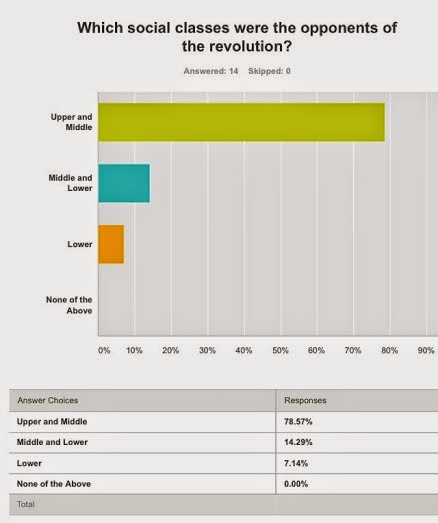
The group I was paired with had the French Revolution of 1848.  Our job was to analyze a source on our Revolution and to create a Survey Monkey quiz for the other groups to take.  The people that were rebelling were the lower class citizens whom believed in the ideology Liberalism.  They rebelled against the upper and middle class citizens.  Quoted from the source of the revolution on edline, "Near the end of the decade, discontent was heightened by a recession, or period of reduced economic activity." These rebels wanted to end the French Recession because obviously it wasn't a glorious time if no one was able to buy anything due to the lack of available jobs which provided pay for everyone.  After fighting and creating the Barricade Saint Antoine, the National Assembly elected a new leader to rule,  Louis Napoleon, nephew of the great Napoleon Bonaparte.  Another reference to the source stated, " From the start, deep differences divided the new government.  Middle-class liberals wanted moderate political reforms.  Socialists wanted far reaching social and economic change..."   These are just a few of the issues that divided the new government so clearly this revolution was not entirely successful.

This screenshot from the survey my group created shows that the class learned from our quiz because the green bar was the correct answer and the majority of the class selected it.


However, this screenshot is an example of the class being confused with the setup of the question on the survey because the answers all vary greatly.  

Based on this activity in creating the survey for the revolution of 1848 and taking the surveys of the other groups' revolutions, the revolutions were neither an ultimate failure nor a success.  The answer that is more leaned towards is that the revolutions did not succeed and therefore they were failures.  These are examples of why the revolutions did not succeed.  The Decembrist Revolt of 1825 was the revolution that failed the most compared to the others.  Stated from the source on this revolution, "The Tsar died on 19 November 1825, and it was weeks later that Nicholas discovered he was to be the next tsar and that Constantine did not want the throne."  This shows that the Tsar that the people wanted was Constantine, not Nicholas.  But Constantine refuses to take the throne leaving Nicholas to do it himself.   The Decembrist revolt did not end in favor of what the people wanted because they didn't get the Tsar they had hoped for.  Next, the revolt in 1848 Hungary did not end too greatly either,  Outbreaks of violence occurred in the streets of Vienna in the Austrian empire.  The Nationalists which were rebelling wanted to end serfdom and to have a Constitution written for them.  In the end, they did have a Constitution written for them so this revolution was partially a success.  Lastly, the Revolution of 1830 France was a partial success because the people did not want Charles X to rule any longer so he left the country and Louis Philippe took over from there.  In conclusion, there is no definite yes or no answer as to whether or not the revolutions were a success or failure but the answer that could be more leaned to was a failure since not everything the rebels wanted was accomplished in the end.     


Saturday, October 25, 2014

Just The Average 19th Century Lifesytle

        Have you ever wondered how countries were ruled in the 19th century?  To begin our lesson on ideologies, we worked in groups to determine the definitions of the words Liberal, Conservative, and Nationalism.  However, we were not able to use the internet for assistance upon figuring out what these words meant.  We also had to create sentences that included each of the terms in them.  Next, our activator was to get the accurate definitions for the words Liberalism, Conservatism, and Nationalism in order to answer the essential question.  All of these terms are the ideologies.  The Essential question was: What were the major political ideologies of the 19th century and how did they influence social and political action?  This activity really helped us get a good understanding of the terms so that we would be able to answer the essential question.    

       The next step in our activity was to create a presentation with our group on the ideology that we were assigned.  My group had to create a presentation that displayed Nationalism.  Nationalism today is very different than it was in the 19th century.  We were told to focus on the meaning of Nationalism as if we were in the 19th century.  In the 19th century, Nationalism was defined as the people being united by customs, and languages and who share cultures and trade; not just by countries.  This influenced social and political action in the 19th century by causing nationalists to believe they need to come together and unify the country.  Also, Nationalism caused social and political action because the people wanted to get rid of foreign rulers that controlled their freedom.   We displayed the ideology in our presentation by having Mike play the nationalist who is defending his country from a Foreign ruler played by Anna who is trying to convince him to be a liberal.

Here is our video presentation!:


        The other two ideologies, Liberalism, and Conservatism, were assigned to the other groups.  Liberalism in the 19th century meant that the governments job was to preserve the rights of its people.  Everyone is born with natural rights and the government had to acknowledge this.  It is not fair if the government gives some people more rights than others.  The groups who had Liberalism for their ideology showed it in their presentations by talking about liberalism and what it meant.  Also, both groups included the topic of the Invisible Hand since it was a good example of Liberalism.  Liberalism influenced social and political action because the people all had the same rights and no one was treated unfairly.  Next, Conservatism in the 19th century was against new ideas and innovations.  The aristocracy wanted to stay in power because they feared that there would be bloodshed.  They influenced others to believe in an aristocracy not a meritocracy.  They showed conservatism in their presentations by creating videos with characters talking about how they shouldn't change things.  The French Revolution was used as an example of what bad things would happen if the people tried to change the original tradition of things.  Conservatism influenced political and social actions in the 19th century since the monarchy and old classes were kept the same and the people all believed in an aristocracy.

          Learning about these 3 ideologies and what they meant in the 19th century compared to what they mean today was very interesting.  In the 19th century, the ideologies definitely seem a bit too extreme!  Overall, it was a great lesson and I enjoyed making a presentation with my group to show what Nationalism meant.


Tuesday, October 14, 2014

Napoleon Bonaparte

        Have you ever heard of Napoleon Bonaparte?  Bonaparte was a man who had a huge impact on the world during the 17th century.  He successfully gained control over France, Italy, Austria, Poland, Venice, Holland, Belgium and many other places around the world.  In class, we focused on the essential question below while learning about Napoleon Bonaparte.


Napoleon Bonaparte.  1769-1821.
http://www.medindia.net/


Essential Question: What was Napoleon's impact on the social, economic, and political systems of Europe?

       Over the course of our research on Napoleon, we viewed the perspectives of two different historical figures from Napoleon's time.  First, we looked at a woman named Madame de Stael's opinion on Napoleon.  Madame de Stael was a member of the nobility and the daughter of King Louis XVI's former financial adviser.  As you can imagine, she was not too happy with the fact that Napoleon was trying to take control of Europe.  Madame de Stael had a good amount of political power and she believed that if Napoleon took over Europe, she would no longer obtain such a power.  Madame de Stael stated, "What particularly characterizes Bonaparte's government is his profound contempt for all the Intellectual riches of human nature: virtue, dignity, religion, enthusiasm."  This quote explains her feelings toward Bonaparte and how she believes he is certainly not suitable for ruling Europe since he has "contempt" towards all of human nature.  Madame de Stael was one person who provided a perspective against Napoleon because she thought it would affect her negatively politically.


Here is a screenshot of the perspectives of Madame de Stael and Marshal Michel Ney.  In groups we annotated the documents, as you can see the notes and highlighted areas of text.


       The second perspective we looked at belonged to Marshal Michel Ney, a soldier during the French Revolution.  Marshal Michel Ney was totally on board with Napoleon Bonaparte.  He stated, "To the emperor Napoleon, our sovereign, belongs alone the right to rule over our beautiful country."  This statement shows how much he appreciated and admired Napoleon because he wanted him to rule over Europe alone.  Marshal Michel Ney enjoyed being a soldier and the thought of joining Napoleon's Army was very exciting so of course he would be on the side that is supporting Napoleon.  Marshal Michel Ney clearly supported Napoleon and encouraged his idea to take over all of Europe.

        Another source that we looked at while learning about Napoleon Bonaparte was called "The Lost Voices of Napoleon Historians".  This is a website that collects passages from text that is now "out of print" or "inaccessible".  The source had a lot of different opinions to offer on Napoleon.  One historian, Andrews, stated,  "Napoleon was so inconsistent in many of his actions, so untrustworthy in much that he said of himself, and so all-inclusive in his ambitious designs that differing interpretations of the man are inevitable,"  Clearly, Andrews was not fond of Napoleon since he described his actions as inconsistent.  However, there were also other historians who provided opinions on behalf of Napoleon.  Tarbell wrote, "that no man ever comprehended more clearly the splendid science of war; he cannot fail to bow to the genius which conceived and executed the Italian campaign, which fought the classic battles of Austerlitz, Jena and Wagram. These deeds are great epics. They move in noble, measured lines, and stir us by their might and perfection. It is only a genius of the most magnificent order which could handle men and materials as Napoleon did."  Tarbell's perspective  was definitely on the side rooting for  Napoleon because his statements all show how much he praised Napoleon.  If you want to check out this interesting webpage, here is the link.  http://www.napoleon-series.org/research/biographies/c_historians.html  

      Overall, there were many different perspectives on Napoleon Bonaparte.  Socially, Napoleon's impact on Europe was positive because he abolished serfdom and nobility so therefore more citizens had rights.  Economically, Napoleon was also mainly positive because he lowered the prices for more people to afford, encouraged new industry, built roads and canals to expand trade, and spread industrialization to parts of Europe like Germany.  Napoleon Bonaparte had a negative impact on the economy of Europe because some of the men that he killed were the men who worked to support their families.  Lastly, Napoleon had both a positive and negative impact politically on Europe because some countries were helped while some countries were hurt.  He also took away power from a lot of rulers.  In conclusion, our research in class helped us get a better understanding on who Napoleon was and the impact he had socially, economically, and politically on Europe.


Thursday, October 9, 2014

Capitalism, Socialism, and Communism

       Today in history class, we did an activity on communism since we are learning about 3 different systems of ruling; capitalism, communism, and socialism.  During the activity, we were all given a certain amount of Hershey kisses.  The majority of the class got 3 candies but I was lucky and got 10 candies.  A few other students also got 10 candies.  This was to separate the rich from the poor.  After receiving our candies, we all went against different people and played rock paper scissors.  If you won, you received a candy; if you lost you gave the person a candy.  Once all of your candies were gone, you had to sit down.  In the end, I had 19 Hershey kisses while others had a lot less or even none.  Then, Mrs. Gallagher took everyone's candy and gave everyone 3 Hershey kisses to show what Communism was.  I was aggravated because I went from 19 Hershey kisses to 3 but others were happy because they had candy again.  I enjoyed the activity but I was also frustrated that I ended with 3 candies instead of 19.

Hershey kiss cartoon 


      During our lesson, we looked at two different figures that wanted to change the way systems of government worked in order to help the poor.  First, a man named Karl Marx (the father of Marxism) developed a theory in which he believed would result in communism for the society.  Marx believed that if the people were left to do what they wanted, society would go through capitalism to socialism and finally it would end in communism.  This would benefit the poor because with communism, it would be a classless society, and everything would be available to everyone.  There would be no "rich" or "poor".  The other man, Adam Smith, developed the Invisible Hand theory.  Smith believed that governments should leave people alone to buy and sell things freely among themselves.  If a store is charging less than you, you will have to lower the price as well because the people will want to go to that other store that sells items for cheaper.  In the end, the stores would be selling high quality things at low prices which helps the poor because they will be able to afford them.

Link to video on Karl Marx: https://www.youtube.com/watch?v=16IMc5mhbZk&feature=youtu.be  

 Link to video on Adam Smith's "The Invisible Hand": https://www.youtube.com/watch?v=ulyVXa-u4wE&feature=youtu.be


        Both of these theories seem very creative and well thought up.  Clearly, both men cared about the poor and wanted things to be fair for everyone.  To choose which system I think was better is very difficult.  Both of the systems allow the society to have a little freedom.  However, I think that Marx's theory is better because it is more intricate and makes the people have to work together, not against each other.  Overall, the Hershey Kisses activity was very interesting and tasty!


Thursday, October 2, 2014

Why spend youth years working in mills?

         During the 1800's, the Industrial Revolution had a huge impact on the way families made their money.  Since the mills became so popular, many girls were interested in working in them.  The young girls wanted a taste of freedom and what better way than living in the big city without the rule of their parents!  They were eager to make their own money, use it to go shopping and buy new clothes.  Some girls had to give the money to their family in order to support them.  A document titled 'The Changing World of American Women', states," Nearly all viewed mill work as a temporary stage in life, a way to escape the limits imposed by a farm, a step towards greater independence."  This quote is significant because it shows that the girls wanted to work in the mills as a way of becoming more independent and escaping the farms.  Although this all may sound great, there were down sides for the girls.  First, they had a lot of limits on their life outside of work.  For example, in mills where the girls lived in boarding houses, they had to follow a strict moral.  If they were caught in town holding hands with a boy, they could be thrown out of the mill.  Also, if the girls were just a minute late to work, they could be fired.  Aside from the strict rules, the girls did gain independence and maturity.  Here is a link to a video about a girl named Lucy who is asked to work at a mill but has to run it through her single father first.  http://ashp.cuny.edu/ashp-documentaries/daughters-of-free-men/  

Sunday, September 28, 2014

MOSI Live Google Hangout

       We have been learning about the poor living and working conditions for the child laborers during the Industrial Revolution.  To further our study, we were able to video chat with a historian who works at the MOSI Museum of Science and Industry in the UK.  His name was Jamie and he had lots of knowledge on the topic we were learning about. To prepare for the chat with him, we explored the website of the MOSI Museum and we looked up the terminology for words that might come up during our discussion.  Some of the terms included roving, peed frames, sliver, draw frame, and carding engine.  Also, in preparation for our chat with Jamie, we watched a video of him talking about his job and what he does.  We then created questions to ask him during the discussion.

      Throughout the course of the discussion with Jamie, I learned tons of interesting information on the Industrial Revolution.  First, I learned that as a whole, the textile process was extremely dangerous.  Little children were brought in to work at the mills and factories in gruesome, unsafe conditions.  The main job for the young ones was to clean the machines, while they were moving!  It is ridiculous that the machines couldn't have been shut off for a few minutes while they were cleaned to avoid the risk of the children getting severely injured.  Next, I learned that overlookers at the mills would have to convince the parents of the children to allow them to come live in the boarding houses and work in the mills.  In some cases, adults would pay for orphans to go work in the mills instead of sending their own child because they didn't want to take any risks.  The industrialization of textile production had a huge impact on families.  On the positive side, the families were able to make more money and everyone was able to work.  However, there were a lot more negatives to the industrialization of textile production.  Before the industrialization of textiles, families had their own looms in their houses.  They were used to all living together and working from home.  The idea of going to work in mills and factories wasn't very exciting when they were already so adapted to working from home.  Most importantly, families didn't like the idea of their young ones working in the mills living on their own, with the risk of getting severely injured.  Jamie certainly knows our history and I'm glad we were able to video chat with him to learn about the Industrial Revolution!
Spinning Loom.  (MOSI Museum Live Chat).
This is the machine that the children had to clean while it was running.  Those white pieces spun at a rapid speed and the children had to put their hands in them with a cleaning tool.

     Overall, I really enjoyed chatting with Jamie and learning all of the information he told us.  I thought it was a great idea to talk to an outside expert about what we are learning in class.  Now, I know a lot more about the topic than I feel I would have if we learned without the help of an expert.  In the future I would definitely like to do stuff like this for other units.