Essential Question: Is Andrew Jackon's long-standing reputation as "the people's president" deserved? Why? Why not?
In the History of the presidents' of the United States, Andrew Jackson was remembered for being "the people's president". This reputation does not make sense considering Andrew Jackson's actions towards the Native Americans. He does not deserve to be remembered for being "the people's president" because that would mean that he was good to all of the people and did everything on their behalf. Although that is quite impossible for a president to do, Jackson absolutely did not have to force the natives to move west away from their homes and into a territory where they were easy targets for other tribes in the west. Jackson made them leave because he wanted to expand the United States. This is the main reason why Andrew Jackson definitely does not deserve the long-standing reputation as "the people's president." Here are the major events that occurred during Andrew Jackson's presidency briefly summarized:
The spoils system was a practice where a political party after winning its elections, it gave the jobs to its supporters so they would keep supporting the party. Andrew Jackson created the Spoils system and not everyone was a fan of it. In fact, 919 officials were removed and therefore, the idea of loyalty being better than competence was popular.
Next, there was the event where the Indians were removed from there homes and sent to live in the west with the dangerous threat of the other tribes living there. Since the white settlers were moving in on their land, and with the command of the president to leave, the Indians had no choice but to venture west. The trip to the west took place in the harsh winter and 10,000 Cherokee Indians died on the trip. Many of the Indians along the way went their own path and the pack grew smaller and smaller. All of this happened because Andrew Jackson wanted to extend the United states.
Lastly, the Bank War was a major issue that occurred during the presidency of Andrew Jackson. The bank was established by congress as a part of the American system. It gave unfair treatment to the wealthy classes over the poor. Jackson was strongly against the bank as an institution. He wrote a letter to congress stating that the bank had too much power and that it was a threat to liberty and independence. This was one of the good things that Jefferson did to help the unfair treatment of his people.
My group created this fun video describing the Bank War, enjoy!
Monday, December 22, 2014

Wednesday, December 3, 2014
Toussiant Louverture, a Leader to Remember!
Ray Kroc once said, "The quality of a leader is reflected in the standards they set for themselves." The leader and ruler of the western half of the large Caribbean island, Hispaniola, went by the name of Touissant Louverture. Louverture was a former slave. The western half of the island was called Saint Domingue but renamed to Haiti in 1804. Saint Domingue was one of the richest colonies in the world while under French control. It was producing 40 percent of the world's sugar, and more than half of the world's coffee in the 1780's. Of course, the people behind all of this hard, successful work were 500,00 slaves. Everything changed for the people of Saint Domingue when word of the French Revolution spread across the island in 1789. Shortly after hearing the word, in 1793, Touissant assembled an army of slaves to fight the French. Touissant ruled from then on and eventually in 1804, Haiti became an indeendent nation. Touissant Louverture should be remembered for his roles of being a liberator of slaves, a military commander, and being the ruler of Saint Dominque.
First, Touissant should be remembered for his most important role of being a liberator of slaves. When he grew up, he was freed and strangely he had slaves of his own doing all sorts of work for him on the plantation. This was how his life went on for sometime. Then, in 1789, word spread across the island of the French Revolution and when the slaves heard, they became interested in revolting themselves with encouragement from Touissant. The slaves achieved freedom for some time after they revolted. However, in 1797, when the French Directory was looking to reinstate slavery, Touissant demonstrated his commitment to being a liberator a slaves in a letter he wrote to the French Directory. He stated in the letter,"Could men who have once enjoyed the benefits of liberty look on calmly while it is taken from them!" (Document B). Touissant argued in the letter that it was totally not fair for the men who had just gained freedom to have to lose it and become slaves again. In the end of the letter he even set up a threat to the French to show that the slaves will put up a fight to preserve their freedom. This shows Touissant's determination as the liberator of slaves to keep the slaves free forever. Another example that shows how much Touissant cared about liberating the slaves is in the Saint Domingue Constitution of 1801. Although the slaves were free, they still needed jobs to make a living and unfourtunately they were still working for the same bosses as when they were enslaved. Touissant made sure that the Constitution stated that all men were equal and that the former slaves will get their pay and be treated like a big family who works on the plantation with the owner of the plantation being like the father. Clearly Touissant's role as being a liberator of slaves is something he definitely should be remembered for.
The second most important quality that Touissant should be remembered for is being a military commander. In 1802, Napoleon sent troops to Saint Domingue in hopes of gaining control over the island again and reinstating slavery. Touissant demonstrated his great military commanding skills by having every one abanon the towns and hide in the mountains to wait for the French to arrive. The French had no idea what guerrilla war style so Touissant cleverly told his men to use that method of war to totally confuse and surprise the French. Athough this example of Touissant's role as a military commander showcases greatness, there was also something he did as a military commander that indicated otherwise. In 1801, the colored people were so fed up with being forced to work all day for the same cruel bosses as when they were slaves that they revolted and massacred whites from Fort Liberte. When Toussaint heard of the revolt, he was so enraged that he ordered his men to fire at the colored people. This shows that Touissant had a different harsh way of commanding the military. Even though Touissant did things that were bad there were also a number of good things he did as a military commander and that is why his role of being a military commander is the second most important quality he should be remembered for.
The third most important quality that Touissant should be remembered for is his role as being ruler of Saint Domingue. Touissant did everything he could to keep order among the people of Saint Domingue. Being a ruler, Touissant had to make extremely tough decisions to keep the people in order. In the Procamation written in 1801, Toussaint stated," All male and feale citizens must obtain a security card. Such card shall contain the family name, address... age and sex of the person who bears it." This statement and rule was to ensure that everyone could be identified. Another example that shows how good of a ruler Touissant was is in the Constitution of Saint Domingue. This goes along with his role of being a liberator of slaves but it also has to do with his ruling. Touissant made sure that all of the people he ruled over were treated equally and that there would be NO unfair treatment or slavery existing among them. It is very important for rulers to ensure that all of the people will be treated fairly and Touissant did a great job in doing so. Therefore, Touissant should be remembered for his role of ruling Saint Domingue.
In conclusion, Touissant should be remembered for his roles of being a liberator of slaves, a military commander, and the ruler of Saint Domingue. His role as being a liberator of slaves is most important because he did so many things to make sure there was an end to slavery. Next, Touissant's role as being a military commander is important because he made a lot of good moves but also a few bad one's. Lastly, his role of being the ruler of Saint Domingue is important to remember because he went out of his way to make sure the people were treated fairly and that there was order among them. When looking back in the world's history, Touissant Louverture should definitely be remembered for the roles of being a liberator of slaves, a military commander, and the ruler of Saint Domingue!
First, Touissant should be remembered for his most important role of being a liberator of slaves. When he grew up, he was freed and strangely he had slaves of his own doing all sorts of work for him on the plantation. This was how his life went on for sometime. Then, in 1789, word spread across the island of the French Revolution and when the slaves heard, they became interested in revolting themselves with encouragement from Touissant. The slaves achieved freedom for some time after they revolted. However, in 1797, when the French Directory was looking to reinstate slavery, Touissant demonstrated his commitment to being a liberator a slaves in a letter he wrote to the French Directory. He stated in the letter,"Could men who have once enjoyed the benefits of liberty look on calmly while it is taken from them!" (Document B). Touissant argued in the letter that it was totally not fair for the men who had just gained freedom to have to lose it and become slaves again. In the end of the letter he even set up a threat to the French to show that the slaves will put up a fight to preserve their freedom. This shows Touissant's determination as the liberator of slaves to keep the slaves free forever. Another example that shows how much Touissant cared about liberating the slaves is in the Saint Domingue Constitution of 1801. Although the slaves were free, they still needed jobs to make a living and unfourtunately they were still working for the same bosses as when they were enslaved. Touissant made sure that the Constitution stated that all men were equal and that the former slaves will get their pay and be treated like a big family who works on the plantation with the owner of the plantation being like the father. Clearly Touissant's role as being a liberator of slaves is something he definitely should be remembered for.
The second most important quality that Touissant should be remembered for is being a military commander. In 1802, Napoleon sent troops to Saint Domingue in hopes of gaining control over the island again and reinstating slavery. Touissant demonstrated his great military commanding skills by having every one abanon the towns and hide in the mountains to wait for the French to arrive. The French had no idea what guerrilla war style so Touissant cleverly told his men to use that method of war to totally confuse and surprise the French. Athough this example of Touissant's role as a military commander showcases greatness, there was also something he did as a military commander that indicated otherwise. In 1801, the colored people were so fed up with being forced to work all day for the same cruel bosses as when they were slaves that they revolted and massacred whites from Fort Liberte. When Toussaint heard of the revolt, he was so enraged that he ordered his men to fire at the colored people. This shows that Touissant had a different harsh way of commanding the military. Even though Touissant did things that were bad there were also a number of good things he did as a military commander and that is why his role of being a military commander is the second most important quality he should be remembered for.
The third most important quality that Touissant should be remembered for is his role as being ruler of Saint Domingue. Touissant did everything he could to keep order among the people of Saint Domingue. Being a ruler, Touissant had to make extremely tough decisions to keep the people in order. In the Procamation written in 1801, Toussaint stated," All male and feale citizens must obtain a security card. Such card shall contain the family name, address... age and sex of the person who bears it." This statement and rule was to ensure that everyone could be identified. Another example that shows how good of a ruler Touissant was is in the Constitution of Saint Domingue. This goes along with his role of being a liberator of slaves but it also has to do with his ruling. Touissant made sure that all of the people he ruled over were treated equally and that there would be NO unfair treatment or slavery existing among them. It is very important for rulers to ensure that all of the people will be treated fairly and Touissant did a great job in doing so. Therefore, Touissant should be remembered for his role of ruling Saint Domingue.
In conclusion, Touissant should be remembered for his roles of being a liberator of slaves, a military commander, and the ruler of Saint Domingue. His role as being a liberator of slaves is most important because he did so many things to make sure there was an end to slavery. Next, Touissant's role as being a military commander is important because he made a lot of good moves but also a few bad one's. Lastly, his role of being the ruler of Saint Domingue is important to remember because he went out of his way to make sure the people were treated fairly and that there was order among them. When looking back in the world's history, Touissant Louverture should definitely be remembered for the roles of being a liberator of slaves, a military commander, and the ruler of Saint Domingue!
Tuesday, November 11, 2014
Several attempts to reform a country
Have you ever heard of the saying, "France sneezed and Europe caught a cold.?" -Klemens Von Metternich. Metternich said this because the French Revolution influenced Europe to start a revolution of it's own. Thus, France sneezed meaning the revolution and Europe caught the cold meaning that it would start a revolution (or several in this case) of its own. This leads to the essential question, Were the revolutions of 1830 and 1848 really failures as many historians have concluded? The following activities that we conducted in class such as researching a revolution and creating quizzes on them were to help us answer the essential question.
The group I was paired with had the French Revolution of 1848. Our job was to analyze a source on our Revolution and to create a Survey Monkey quiz for the other groups to take. The people that were rebelling were the lower class citizens whom believed in the ideology Liberalism. They rebelled against the upper and middle class citizens. Quoted from the source of the revolution on edline, "Near the end of the decade, discontent was heightened by a recession, or period of reduced economic activity." These rebels wanted to end the French Recession because obviously it wasn't a glorious time if no one was able to buy anything due to the lack of available jobs which provided pay for everyone. After fighting and creating the Barricade Saint Antoine, the National Assembly elected a new leader to rule, Louis Napoleon, nephew of the great Napoleon Bonaparte. Another reference to the source stated, " From the start, deep differences divided the new government. Middle-class liberals wanted moderate political reforms. Socialists wanted far reaching social and economic change..." These are just a few of the issues that divided the new government so clearly this revolution was not entirely successful.
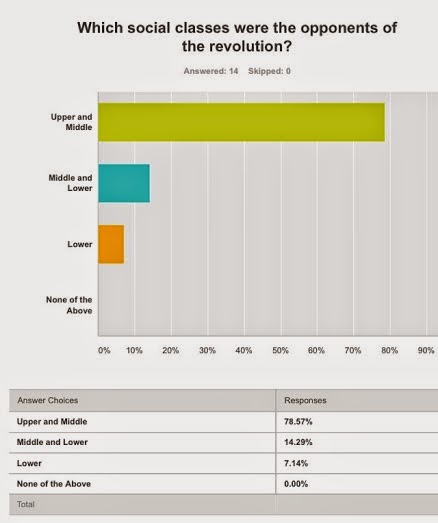
This screenshot from the survey my group created shows that the class learned from our quiz because the green bar was the correct answer and the majority of the class selected it.


The group I was paired with had the French Revolution of 1848. Our job was to analyze a source on our Revolution and to create a Survey Monkey quiz for the other groups to take. The people that were rebelling were the lower class citizens whom believed in the ideology Liberalism. They rebelled against the upper and middle class citizens. Quoted from the source of the revolution on edline, "Near the end of the decade, discontent was heightened by a recession, or period of reduced economic activity." These rebels wanted to end the French Recession because obviously it wasn't a glorious time if no one was able to buy anything due to the lack of available jobs which provided pay for everyone. After fighting and creating the Barricade Saint Antoine, the National Assembly elected a new leader to rule, Louis Napoleon, nephew of the great Napoleon Bonaparte. Another reference to the source stated, " From the start, deep differences divided the new government. Middle-class liberals wanted moderate political reforms. Socialists wanted far reaching social and economic change..." These are just a few of the issues that divided the new government so clearly this revolution was not entirely successful.
This screenshot from the survey my group created shows that the class learned from our quiz because the green bar was the correct answer and the majority of the class selected it.
However, this screenshot is an example of the class being confused with the setup of the question on the survey because the answers all vary greatly.

Based on this activity in creating the survey for the revolution of 1848 and taking the surveys of the other groups' revolutions, the revolutions were neither an ultimate failure nor a success. The answer that is more leaned towards is that the revolutions did not succeed and therefore they were failures. These are examples of why the revolutions did not succeed. The Decembrist Revolt of 1825 was the revolution that failed the most compared to the others. Stated from the source on this revolution, "The Tsar died on 19 November 1825, and it was weeks later that Nicholas discovered he was to be the next tsar and that Constantine did not want the throne." This shows that the Tsar that the people wanted was Constantine, not Nicholas. But Constantine refuses to take the throne leaving Nicholas to do it himself. The Decembrist revolt did not end in favor of what the people wanted because they didn't get the Tsar they had hoped for. Next, the revolt in 1848 Hungary did not end too greatly either, Outbreaks of violence occurred in the streets of Vienna in the Austrian empire. The Nationalists which were rebelling wanted to end serfdom and to have a Constitution written for them. In the end, they did have a Constitution written for them so this revolution was partially a success. Lastly, the Revolution of 1830 France was a partial success because the people did not want Charles X to rule any longer so he left the country and Louis Philippe took over from there. In conclusion, there is no definite yes or no answer as to whether or not the revolutions were a success or failure but the answer that could be more leaned to was a failure since not everything the rebels wanted was accomplished in the end.
Saturday, October 25, 2014
Just The Average 19th Century Lifesytle
Have you ever wondered how countries were ruled in the 19th century? To begin our lesson on ideologies, we worked in groups to determine the definitions of the words Liberal, Conservative, and Nationalism. However, we were not able to use the internet for assistance upon figuring out what these words meant. We also had to create sentences that included each of the terms in them. Next, our activator was to get the accurate definitions for the words Liberalism, Conservatism, and Nationalism in order to answer the essential question. All of these terms are the ideologies. The Essential question was: What were the major political ideologies of the 19th century and how did they influence social and political action? This activity really helped us get a good understanding of the terms so that we would be able to answer the essential question.
The next step in our activity was to create a presentation with our group on the ideology that we were assigned. My group had to create a presentation that displayed Nationalism. Nationalism today is very different than it was in the 19th century. We were told to focus on the meaning of Nationalism as if we were in the 19th century. In the 19th century, Nationalism was defined as the people being united by customs, and languages and who share cultures and trade; not just by countries. This influenced social and political action in the 19th century by causing nationalists to believe they need to come together and unify the country. Also, Nationalism caused social and political action because the people wanted to get rid of foreign rulers that controlled their freedom. We displayed the ideology in our presentation by having Mike play the nationalist who is defending his country from a Foreign ruler played by Anna who is trying to convince him to be a liberal.
Here is our video presentation!:
The other two ideologies, Liberalism, and Conservatism, were assigned to the other groups. Liberalism in the 19th century meant that the governments job was to preserve the rights of its people. Everyone is born with natural rights and the government had to acknowledge this. It is not fair if the government gives some people more rights than others. The groups who had Liberalism for their ideology showed it in their presentations by talking about liberalism and what it meant. Also, both groups included the topic of the Invisible Hand since it was a good example of Liberalism. Liberalism influenced social and political action because the people all had the same rights and no one was treated unfairly. Next, Conservatism in the 19th century was against new ideas and innovations. The aristocracy wanted to stay in power because they feared that there would be bloodshed. They influenced others to believe in an aristocracy not a meritocracy. They showed conservatism in their presentations by creating videos with characters talking about how they shouldn't change things. The French Revolution was used as an example of what bad things would happen if the people tried to change the original tradition of things. Conservatism influenced political and social actions in the 19th century since the monarchy and old classes were kept the same and the people all believed in an aristocracy.
Learning about these 3 ideologies and what they meant in the 19th century compared to what they mean today was very interesting. In the 19th century, the ideologies definitely seem a bit too extreme! Overall, it was a great lesson and I enjoyed making a presentation with my group to show what Nationalism meant.
The next step in our activity was to create a presentation with our group on the ideology that we were assigned. My group had to create a presentation that displayed Nationalism. Nationalism today is very different than it was in the 19th century. We were told to focus on the meaning of Nationalism as if we were in the 19th century. In the 19th century, Nationalism was defined as the people being united by customs, and languages and who share cultures and trade; not just by countries. This influenced social and political action in the 19th century by causing nationalists to believe they need to come together and unify the country. Also, Nationalism caused social and political action because the people wanted to get rid of foreign rulers that controlled their freedom. We displayed the ideology in our presentation by having Mike play the nationalist who is defending his country from a Foreign ruler played by Anna who is trying to convince him to be a liberal.
Here is our video presentation!:
The other two ideologies, Liberalism, and Conservatism, were assigned to the other groups. Liberalism in the 19th century meant that the governments job was to preserve the rights of its people. Everyone is born with natural rights and the government had to acknowledge this. It is not fair if the government gives some people more rights than others. The groups who had Liberalism for their ideology showed it in their presentations by talking about liberalism and what it meant. Also, both groups included the topic of the Invisible Hand since it was a good example of Liberalism. Liberalism influenced social and political action because the people all had the same rights and no one was treated unfairly. Next, Conservatism in the 19th century was against new ideas and innovations. The aristocracy wanted to stay in power because they feared that there would be bloodshed. They influenced others to believe in an aristocracy not a meritocracy. They showed conservatism in their presentations by creating videos with characters talking about how they shouldn't change things. The French Revolution was used as an example of what bad things would happen if the people tried to change the original tradition of things. Conservatism influenced political and social actions in the 19th century since the monarchy and old classes were kept the same and the people all believed in an aristocracy.
Learning about these 3 ideologies and what they meant in the 19th century compared to what they mean today was very interesting. In the 19th century, the ideologies definitely seem a bit too extreme! Overall, it was a great lesson and I enjoyed making a presentation with my group to show what Nationalism meant.
Tuesday, October 14, 2014
Napoleon Bonaparte
Have you ever heard of Napoleon Bonaparte? Bonaparte was a man who had a huge impact on the world during the 17th century. He successfully gained control over France, Italy, Austria, Poland, Venice, Holland, Belgium and many other places around the world. In class, we focused on the essential question below while learning about Napoleon Bonaparte.

Napoleon Bonaparte. 1769-1821.
http://www.medindia.net/
Essential Question: What was Napoleon's impact on the social, economic, and political systems of Europe?
Over the course of our research on Napoleon, we viewed the perspectives of two different historical figures from Napoleon's time. First, we looked at a woman named Madame de Stael's opinion on Napoleon. Madame de Stael was a member of the nobility and the daughter of King Louis XVI's former financial adviser. As you can imagine, she was not too happy with the fact that Napoleon was trying to take control of Europe. Madame de Stael had a good amount of political power and she believed that if Napoleon took over Europe, she would no longer obtain such a power. Madame de Stael stated, "What particularly characterizes Bonaparte's government is his profound contempt for all the Intellectual riches of human nature: virtue, dignity, religion, enthusiasm." This quote explains her feelings toward Bonaparte and how she believes he is certainly not suitable for ruling Europe since he has "contempt" towards all of human nature. Madame de Stael was one person who provided a perspective against Napoleon because she thought it would affect her negatively politically.
![]()
.jpg)
The second perspective we looked at belonged to Marshal Michel Ney, a soldier during the French Revolution. Marshal Michel Ney was totally on board with Napoleon Bonaparte. He stated, "To the emperor Napoleon, our sovereign, belongs alone the right to rule over our beautiful country." This statement shows how much he appreciated and admired Napoleon because he wanted him to rule over Europe alone. Marshal Michel Ney enjoyed being a soldier and the thought of joining Napoleon's Army was very exciting so of course he would be on the side that is supporting Napoleon. Marshal Michel Ney clearly supported Napoleon and encouraged his idea to take over all of Europe.
Another source that we looked at while learning about Napoleon Bonaparte was called "The Lost Voices of Napoleon Historians". This is a website that collects passages from text that is now "out of print" or "inaccessible". The source had a lot of different opinions to offer on Napoleon. One historian, Andrews, stated, "Napoleon was so inconsistent in many of his actions, so untrustworthy in much that he said of himself, and so all-inclusive in his ambitious designs that differing interpretations of the man are inevitable," Clearly, Andrews was not fond of Napoleon since he described his actions as inconsistent. However, there were also other historians who provided opinions on behalf of Napoleon. Tarbell wrote, "that no man ever comprehended more clearly the splendid science of war; he cannot fail to bow to the genius which conceived and executed the Italian campaign, which fought the classic battles of Austerlitz, Jena and Wagram. These deeds are great epics. They move in noble, measured lines, and stir us by their might and perfection. It is only a genius of the most magnificent order which could handle men and materials as Napoleon did." Tarbell's perspective was definitely on the side rooting for Napoleon because his statements all show how much he praised Napoleon. If you want to check out this interesting webpage, here is the link. http://www.napoleon-series.org/research/biographies/c_historians.html
Overall, there were many different perspectives on Napoleon Bonaparte. Socially, Napoleon's impact on Europe was positive because he abolished serfdom and nobility so therefore more citizens had rights. Economically, Napoleon was also mainly positive because he lowered the prices for more people to afford, encouraged new industry, built roads and canals to expand trade, and spread industrialization to parts of Europe like Germany. Napoleon Bonaparte had a negative impact on the economy of Europe because some of the men that he killed were the men who worked to support their families. Lastly, Napoleon had both a positive and negative impact politically on Europe because some countries were helped while some countries were hurt. He also took away power from a lot of rulers. In conclusion, our research in class helped us get a better understanding on who Napoleon was and the impact he had socially, economically, and politically on Europe.
Napoleon Bonaparte. 1769-1821.
http://www.medindia.net/
Essential Question: What was Napoleon's impact on the social, economic, and political systems of Europe?
Over the course of our research on Napoleon, we viewed the perspectives of two different historical figures from Napoleon's time. First, we looked at a woman named Madame de Stael's opinion on Napoleon. Madame de Stael was a member of the nobility and the daughter of King Louis XVI's former financial adviser. As you can imagine, she was not too happy with the fact that Napoleon was trying to take control of Europe. Madame de Stael had a good amount of political power and she believed that if Napoleon took over Europe, she would no longer obtain such a power. Madame de Stael stated, "What particularly characterizes Bonaparte's government is his profound contempt for all the Intellectual riches of human nature: virtue, dignity, religion, enthusiasm." This quote explains her feelings toward Bonaparte and how she believes he is certainly not suitable for ruling Europe since he has "contempt" towards all of human nature. Madame de Stael was one person who provided a perspective against Napoleon because she thought it would affect her negatively politically.
Here is a screenshot of the perspectives of Madame de Stael and Marshal Michel Ney. In groups we annotated the documents, as you can see the notes and highlighted areas of text.
The second perspective we looked at belonged to Marshal Michel Ney, a soldier during the French Revolution. Marshal Michel Ney was totally on board with Napoleon Bonaparte. He stated, "To the emperor Napoleon, our sovereign, belongs alone the right to rule over our beautiful country." This statement shows how much he appreciated and admired Napoleon because he wanted him to rule over Europe alone. Marshal Michel Ney enjoyed being a soldier and the thought of joining Napoleon's Army was very exciting so of course he would be on the side that is supporting Napoleon. Marshal Michel Ney clearly supported Napoleon and encouraged his idea to take over all of Europe.
Another source that we looked at while learning about Napoleon Bonaparte was called "The Lost Voices of Napoleon Historians". This is a website that collects passages from text that is now "out of print" or "inaccessible". The source had a lot of different opinions to offer on Napoleon. One historian, Andrews, stated, "Napoleon was so inconsistent in many of his actions, so untrustworthy in much that he said of himself, and so all-inclusive in his ambitious designs that differing interpretations of the man are inevitable," Clearly, Andrews was not fond of Napoleon since he described his actions as inconsistent. However, there were also other historians who provided opinions on behalf of Napoleon. Tarbell wrote, "that no man ever comprehended more clearly the splendid science of war; he cannot fail to bow to the genius which conceived and executed the Italian campaign, which fought the classic battles of Austerlitz, Jena and Wagram. These deeds are great epics. They move in noble, measured lines, and stir us by their might and perfection. It is only a genius of the most magnificent order which could handle men and materials as Napoleon did." Tarbell's perspective was definitely on the side rooting for Napoleon because his statements all show how much he praised Napoleon. If you want to check out this interesting webpage, here is the link. http://www.napoleon-series.org/research/biographies/c_historians.html
Overall, there were many different perspectives on Napoleon Bonaparte. Socially, Napoleon's impact on Europe was positive because he abolished serfdom and nobility so therefore more citizens had rights. Economically, Napoleon was also mainly positive because he lowered the prices for more people to afford, encouraged new industry, built roads and canals to expand trade, and spread industrialization to parts of Europe like Germany. Napoleon Bonaparte had a negative impact on the economy of Europe because some of the men that he killed were the men who worked to support their families. Lastly, Napoleon had both a positive and negative impact politically on Europe because some countries were helped while some countries were hurt. He also took away power from a lot of rulers. In conclusion, our research in class helped us get a better understanding on who Napoleon was and the impact he had socially, economically, and politically on Europe.
Thursday, October 9, 2014
Capitalism, Socialism, and Communism
Today in history class, we did an activity on communism since we are learning about 3 different systems of ruling; capitalism, communism, and socialism. During the activity, we were all given a certain amount of Hershey kisses. The majority of the class got 3 candies but I was lucky and got 10 candies. A few other students also got 10 candies. This was to separate the rich from the poor. After receiving our candies, we all went against different people and played rock paper scissors. If you won, you received a candy; if you lost you gave the person a candy. Once all of your candies were gone, you had to sit down. In the end, I had 19 Hershey kisses while others had a lot less or even none. Then, Mrs. Gallagher took everyone's candy and gave everyone 3 Hershey kisses to show what Communism was. I was aggravated because I went from 19 Hershey kisses to 3 but others were happy because they had candy again. I enjoyed the activity but I was also frustrated that I ended with 3 candies instead of 19.

Hershey kiss cartoon
During our lesson, we looked at two different figures that wanted to change the way systems of government worked in order to help the poor. First, a man named Karl Marx (the father of Marxism) developed a theory in which he believed would result in communism for the society. Marx believed that if the people were left to do what they wanted, society would go through capitalism to socialism and finally it would end in communism. This would benefit the poor because with communism, it would be a classless society, and everything would be available to everyone. There would be no "rich" or "poor". The other man, Adam Smith, developed the Invisible Hand theory. Smith believed that governments should leave people alone to buy and sell things freely among themselves. If a store is charging less than you, you will have to lower the price as well because the people will want to go to that other store that sells items for cheaper. In the end, the stores would be selling high quality things at low prices which helps the poor because they will be able to afford them.
Link to video on Karl Marx: https://www.youtube.com/watch?v=16IMc5mhbZk&feature=youtu.be
Link to video on Adam Smith's "The Invisible Hand": https://www.youtube.com/watch?v=ulyVXa-u4wE&feature=youtu.be
Both of these theories seem very creative and well thought up. Clearly, both men cared about the poor and wanted things to be fair for everyone. To choose which system I think was better is very difficult. Both of the systems allow the society to have a little freedom. However, I think that Marx's theory is better because it is more intricate and makes the people have to work together, not against each other. Overall, the Hershey Kisses activity was very interesting and tasty!
Hershey kiss cartoon
During our lesson, we looked at two different figures that wanted to change the way systems of government worked in order to help the poor. First, a man named Karl Marx (the father of Marxism) developed a theory in which he believed would result in communism for the society. Marx believed that if the people were left to do what they wanted, society would go through capitalism to socialism and finally it would end in communism. This would benefit the poor because with communism, it would be a classless society, and everything would be available to everyone. There would be no "rich" or "poor". The other man, Adam Smith, developed the Invisible Hand theory. Smith believed that governments should leave people alone to buy and sell things freely among themselves. If a store is charging less than you, you will have to lower the price as well because the people will want to go to that other store that sells items for cheaper. In the end, the stores would be selling high quality things at low prices which helps the poor because they will be able to afford them.
Link to video on Karl Marx: https://www.youtube.com/watch?v=16IMc5mhbZk&feature=youtu.be
Link to video on Adam Smith's "The Invisible Hand": https://www.youtube.com/watch?v=ulyVXa-u4wE&feature=youtu.be
Both of these theories seem very creative and well thought up. Clearly, both men cared about the poor and wanted things to be fair for everyone. To choose which system I think was better is very difficult. Both of the systems allow the society to have a little freedom. However, I think that Marx's theory is better because it is more intricate and makes the people have to work together, not against each other. Overall, the Hershey Kisses activity was very interesting and tasty!
Thursday, October 2, 2014
Why spend youth years working in mills?
During the 1800's, the Industrial Revolution had a huge impact on the way families made their money. Since the mills became so popular, many girls were interested in working in them. The young girls wanted a taste of freedom and what better way than living in the big city without the rule of their parents! They were eager to make their own money, use it to go shopping and buy new clothes. Some girls had to give the money to their family in order to support them. A document titled 'The Changing World of American Women', states," Nearly all viewed mill work as a temporary stage in life, a way to escape the limits imposed by a farm, a step towards greater independence." This quote is significant because it shows that the girls wanted to work in the mills as a way of becoming more independent and escaping the farms. Although this all may sound great, there were down sides for the girls. First, they had a lot of limits on their life outside of work. For example, in mills where the girls lived in boarding houses, they had to follow a strict moral. If they were caught in town holding hands with a boy, they could be thrown out of the mill. Also, if the girls were just a minute late to work, they could be fired. Aside from the strict rules, the girls did gain independence and maturity. Here is a link to a video about a girl named Lucy who is asked to work at a mill but has to run it through her single father first. http://ashp.cuny.edu/ashp-documentaries/daughters-of-free-men/
Subscribe to:
Posts (Atom)